
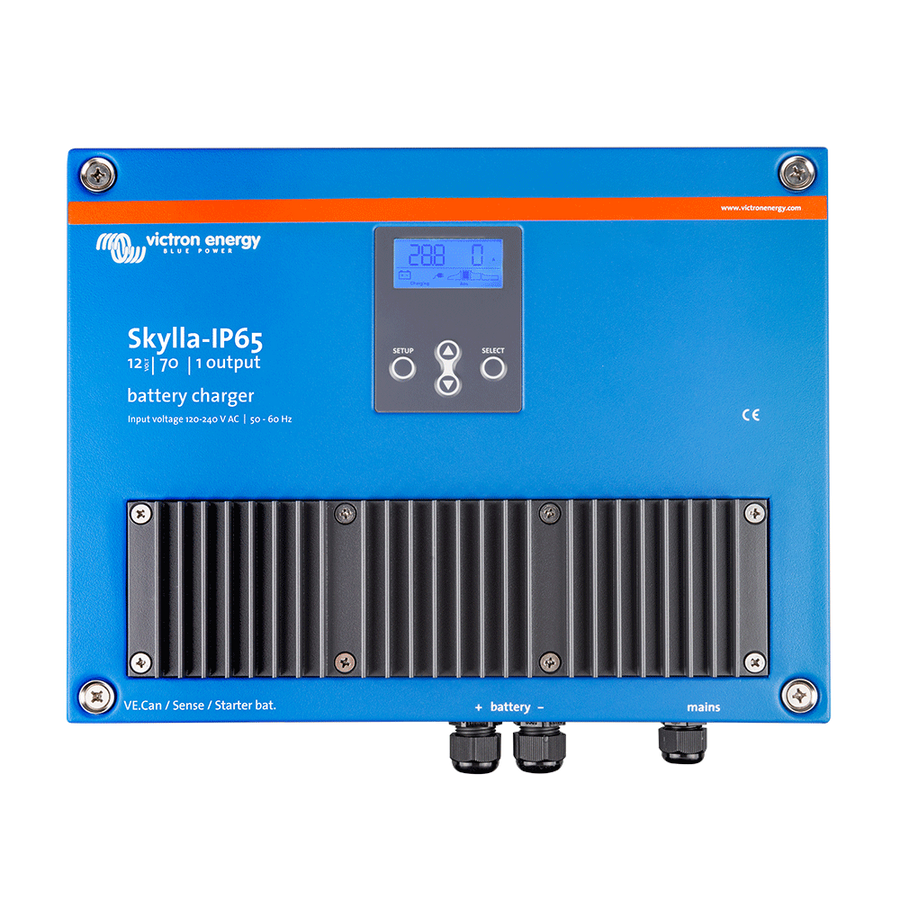
Victron Skylla-IP65 12/70 (1+1) 120-240 V Battery Charger
Victron Skylla IP 65 12/70 Battery Charger
A powerful, waterproof, and intelligent battery charger with a 7-step adaptive charging algorithm, suitable for a variety of battery types and chemistries with a special lithium-ion charging algorithm.
The wide range of universal input voltage increases installation flexibility; the charger maintains its full output power regardless of its location in the world.
Due to its IP65 protection rating, this charger is particularly suitable for use in marine, mobile, and industrial applications, and withstands adverse environmental conditions: heat, humidity, and salt air.
Skylla-IP65 (1+1): two outputs for charging two battery banks
The Skylla-IP65 (1+1) has 2 separate outputs. The second output is intended for charging the starter battery. Consequently, it is limited to 3 A and has a slightly lower output voltage for float charging the typically full starter battery.
Skylla-IP65 (3): three full current outputs for charging 3 battery banks
The Skylla-IP65 (3) has 3 separate outputs. All outputs can deliver the full nominal output current. IP65 Protection Epoxy powder-coated steel housing and splash-proof. Withstands the challenges of a harsh environment: heat, humidity, and salty air. An acrylic coating provides the best possible protection against corrosion for the PCBs. Temperature sensors ensure that the power components always operate within the specified limits. In extreme environmental conditions, the output current is automatically reduced if necessary.
LCD Display
For status monitoring and easy adjustment of charging algorithms to a specific battery and its operating conditions. CAN-Bus Interface (NMEA2000) For connection to a CAN-Bus network, a Skylla-i control panel, or the Color Control digital display. Synchronized Parallel Operation Multiple chargers can be connected in parallel and synchronized using a CAN-Bus interface. This is achieved by simply connecting the chargers to each other via RJ45 UTP cables.
The right amount of charge for a lead-acid battery: adapted absorption time
If only shallow discharges occur, the absorption time is kept short to prevent overcharging the battery. After a deep discharge, the absorption phase is automatically extended to ensure the battery fully charges.
Prevention of damage due to excessive gassing:
The BatterySafe Mode To shorten the charging time, the goal is to use the highest possible charging current in conjunction with a high absorption voltage. However, to prevent excessive gas evolution towards the end of the constant current phase, the Skylla-IP65 limits the rate of voltage increase after the gassing voltage has been reached.
Less maintenance and aging during battery inactivity:
The Storage Mode Storage mode is activated whenever no discharge has occurred within 24 hours. In storage mode, the float voltage is then reduced to 2.2 V/cell (26.4 V for a 24 V battery) to minimize gas evolution and corrosion on the positive plates. Once a week, the voltage is raised back to the absorption voltage threshold to 'refresh' the battery. This achieves a type of equalization charge that prevents electrolyte stratification and sulfation - the two main reasons for premature battery failure. Longer battery life through temperature compensation A battery temperature sensor is supplied with each Skylla-IP65 device. The temperature sensor ensures a decreasing charging voltage with increasing battery temperature. This is particularly important for gel batteries or when constantly high temperature fluctuations are expected.
Battery voltage sensor
To compensate for voltage losses due to cable resistance, the Skylla-IP65 has a voltage sensor in the charging circuit so that the battery always receives the correct charging current.
Use as a power supply
Due to its excellent control circuit, the Skylla-IP65 can be used as a power supply with a perfectly stabilized output voltage when no batteries or large buffer capacitors are available.
Suitable for lithium-ion batteries (LiFePo4)
A simple on/off control can be implemented by connecting a relay or an optocoupler open collector output from a Li-Ion BMS to the remote control terminal of the charger. Alternatively, voltage and current can be fully controlled by connecting to the CAN-Bus port.