
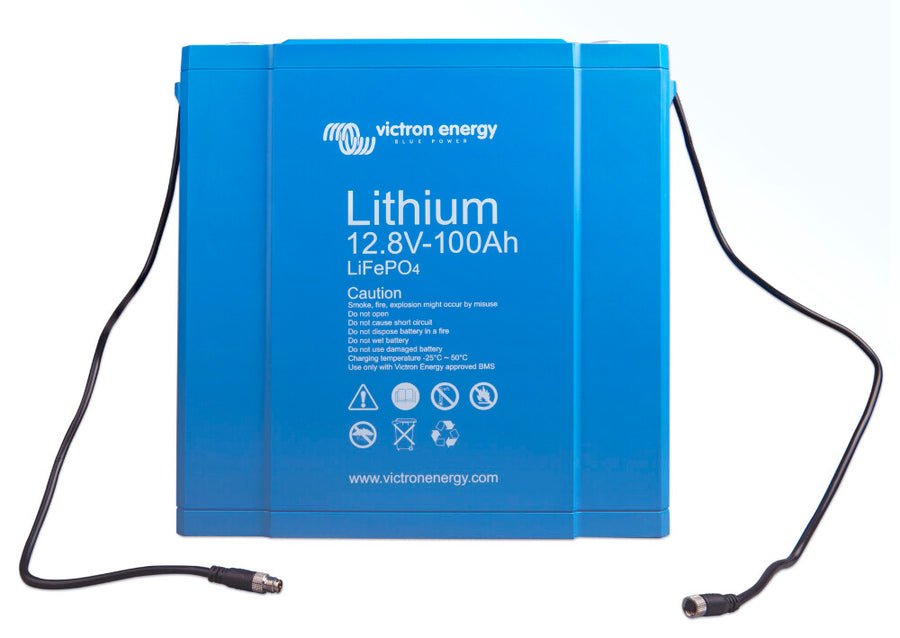
Victron Smart Lithium 100 Ah LiFePO4 Battery 12.8V
Space and weight-saving batteries with Lithium Iron Phosphate Technology from Victron
Why Lithium Iron Phosphate?
The Lithium Iron Phosphate (LiFePO4 or LFP) battery is the safest of the regular lithium iron battery types. The nominal voltage of an LFP cell is 3.2V (Lead-Acid: 2V/cell). A 12.8V LFP battery therefore consists of 4 cells connected in series and a 25.6V battery consists of 8 cells connected in series.
Robust
A lead-acid battery will fail prematurely due to sulfation in the following cases:
- If it is operated for a long time in an insufficiently charged state (i.e., if the battery is rarely or never fully charged).
- If it is left in a partially charged or, even worse, completely discharged state (yacht or motorhome during winter).
An LFP battery does not need to be fully charged. The operating life even slightly increases if the battery is only partially charged instead of fully charged. This is a significant advantage of LFP batteries compared to lead-acid batteries.
Further advantages include a wide operating temperature range, excellent cycling, low internal resistance, and high efficiency (see below).
The LFP battery is therefore the best choice for demanding use.
Efficient
In many applications (especially off-grid solar and/or wind power systems), energy efficiency can be crucial.
The energy efficiency of a charging cycle (discharging from 100% to 0% and recharging to 100%) of an average lead-acid battery is approximately 80%. The energy efficiency of an LFP battery's charging cycle, on the other hand, is 92%.
The charging process of a lead-acid battery becomes particularly inefficient once the 80% state of charge mark has been reached. This leads to energy efficiencies of only 50%.
In solar systems, this value is even lower, as energy reserves for several days are needed there (the battery operates at a state of charge between 70% and 100%).
An LFP battery, on the other hand, still achieves an energy efficiency of 90%, even when it is in a shallow discharge state.
Size and Weight
Space savings of up to 70% Weight savings of up to 70%
Expensive?
LFP batteries are expensive compared to lead-acid batteries. However, the higher acquisition costs will more than pay off in demanding applications due to the longer operating life, high reliability, and excellent energy efficiency.
Bluetooth
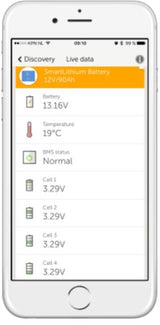
Cell voltages, temperature, and alarm status can be monitored via Bluetooth. This is very useful for detecting a (potential) problem such as cell imbalance.
Battery Management System (BMS)
The BMS can be connected to the BTVs and its main functions include:
- Interrupting or shutting off the load if the voltage of a battery cell drops below 2.5 V.
- Stopping the charging process if the voltage of a battery cell rises above 4.2 V.
- Shutting down the system if the cell temperature exceeds 50°C.
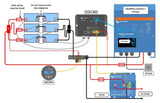
Victron LFP batteries have integrated cell balancing and cell monitoring functions. Up to ten batteries can be connected in parallel and up to four batteries in series, allowing for a 48 V battery bank of up to 3000 Ah. An example wiring diagram can be found in the product images. The cell balancing/monitoring cables can be daisy-chained and must be connected to a Battery Management System (BMS).
Technical data:
